/

Most ad strategies are built around clicks, leads, and platform metrics. Real performance starts when spend is tied directly to revenue, ROAS, and the business outcomes that prove what is actually working.
If you can't answer that clearly, you're not optimizing your ads. You're speculating.
When you allocate ad budget toward growth, how confident are you in the decisions you're making?
Most teams point to dashboards full of impressions, clicks, traffic, lead cost, and lead volume. The reports look productive. The numbers move.
But movement is not return.
And activity is not performance.
If your strategy isn't tied to revenue, you're not optimizing the spend. You're guessing at it.
This is the gap that separates agencies that talk about performance from agencies that produce it. The first group reports on what happened inside the ad platform. The second group reports on what came back to the business.
Most clients have only ever been shown the first version, which is why they think it's the standard.
It isn't. It's the surface.
Most agencies and ppc professionals report on cost per conversion and conversion volume, as well as cost per click, web traffic, and other noise data. They frame the work as performance management.
It isn't performance management.
It's performative, built around metrics that demonstrate effort without proving outcome. The dashboard fills up. The slide deck looks credible. The actual question of whether the spend produced revenue stays unanswered.
The system was never built to answer it.
When you optimize around cost per lead, how do you actually know those leads are producing your best customers?
You don't. You're inferring.
They show that something is happening, not whether it matters. Even leads and conversions, while closer to the truth, stop short of what defines real performance. Because none of them answer the only question that counts.
What came back?
Lower cost does not mean higher return. Most ad strategies break on that single assumption.
Inside a typical optimization decision, a campaign generating cheaper leads gets scaled. A campaign generating more expensive leads gets paused.
The logic feels disciplined. The math feels sound.
Which is exactly why the mistake survives.
But what if the cheaper leads are converting to lower-value customers? What if the campaigns being cut were the ones producing the most profitable jobs?
Without revenue attribution, those questions can't be answered.
So the work continues on what's visible: cost, volume, surface efficiency. The campaigns that look good get scaled. The ones that look expensive get cut. The campaigns actually driving growth often sit underneath both, invisible until revenue data exposes them.
That's where strategy quietly breaks.
Not in the campaigns. In the decisions made about them.
Google. Bing. Meta. Every business has access to the same tools, the same audiences, the same reach.
The difference between an ad strategy that performs and one that drains budget isn't the platform. It isn't the creative. It isn't the targeting.
It's the decisions behind the spend.
And those decisions are only as strong as the data guiding them.
When reporting stops at the lead, everything after that becomes assumption. Close rates get estimated. Deal values get averaged. Campaign performance gets inferred from patterns that may or may not hold.
Strategy starts to rely on what seems right rather than what's proven.
That isn't strategy. That's speculation.
Real performance advertising begins when campaigns are tied back to revenue clearly enough to guide decisions based on return.
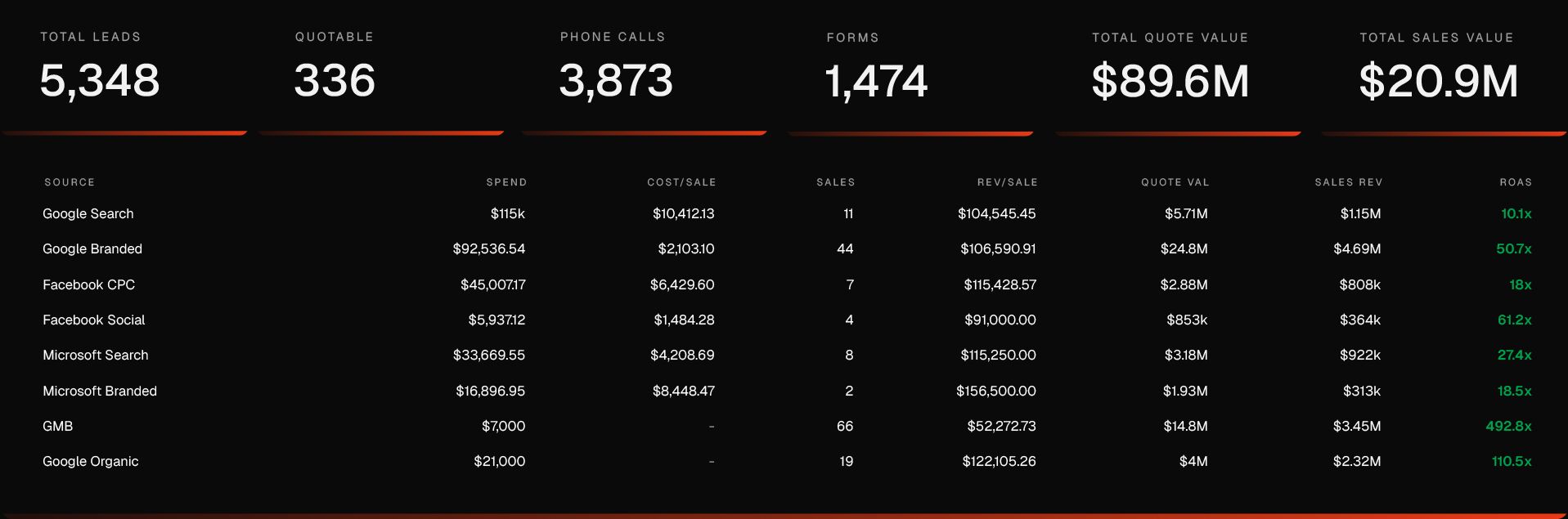
ROAS, return on ad spend, answers a single question.
For every dollar invested, how much revenue comes back?
That answer changes what gets scaled. A campaign producing fewer, more expensive leads can outperform a high-volume campaign on every metric that actually matters. Without ROAS visibility, that campaign gets cut.
With it, that campaign gets scaled.
Because the data finally shows what's producing the business, not just what's producing activity.
ROAS isn't a better metric. It's a different lens. One built on outcome instead of motion.
Once it's in place, the question shifts. From how do we lower cost per lead, to where should we invest to drive more revenue.
That single change turns campaign management into capital allocation.
The shift to ROAS doesn't only change what gets scaled. It changes how spend gets allocated against the entire business.
Because revenue attribution makes efficiency visible for the first time.
Two campaigns can produce the same revenue and not be equal.
Ten jobs that return one million dollars in revenue are not the same as thirty jobs that return one million dollars. The top line matches. Everything underneath it doesn't.
Fewer jobs means less fulfillment cost. Less labor. Less operational drag. Higher net to the business.
ROAS reveals that difference. Cost per lead never could.
When the data shows which campaigns produce higher-value customers, bidding shifts toward those customers. Budget moves toward fewer, larger, more profitable transactions instead of toward volume for its own sake.
Allocation stops being about how much revenue is generated and starts being about how efficiently it's generated.
That's the layer most agencies never reach.
Yield and efficiency, optimized together.
Less than 4% of U.S. agencies can show true ROAS in real time.
Not because it isn't valuable. Because it's hard.
It requires connecting the full path. Click to lead the customer to revenue. Across ad platforms, call and form tracking, and CRM data. In real time, clean and accurate, with revenue attributed back to the specific keyword, campaign, and audience that produced it.
Most agencies stop at platform-reported conversions. That's where the technical work ends and the operational work begins.
Building full-path attribution requires integration, infrastructure, and a willingness to be measured against revenue rather than activity.
Most agencies report what's easy to see.
Very few build what's necessary to decide.
When you look at your ads right now, are you seeing activity, or are you seeing return?
When the next budget meeting happens, will the decisions get made on what came back, or on what looks efficient on a platform dashboard?
The brands that figure this out first are not the ones with the biggest budgets. They are the ones who stopped trusting the surface and started asking the only question that matters.
If it's not tied to revenue, it's speculation.

If your website isn’t making you money, let’s be honest, it’s just a pretty (or not so pretty) digital brochure. And in 2025, brochures don’t close deals. A high-converting website is like having a 24/7 salesperson: it greets potential customers, answers their questions, and nudges them to pick up the phone or hit that “Book Now” button. The good news?…

When people search for a service business in their area, one of the first things they see is the Google Business Profile. It is the map listing, the star rating, the quick facts about who you are and what you do. For many, it is the deciding factor between a call and a scroll. Google reports that businesses with complete…
A recent poll from ppcsurvey.com showed that 52% of marketers say PPC has become more challenging, yet only 8% are changing how they manage it. What’s your strategy for 2026?